This one came from pain, not strategy.
Bug reports were arriving where they always arrive in real teams: in messenger chats.
Sometimes it was a clean report. More often it was a screenshot, a voice-note-level description typed in a rush, or a half-panicked "this is broken again" dropped into Telegram with three follow-up replies underneath it.
And every time the same stupid ritual started again:
- scroll back through the chat
- figure out what the actual issue is
- rewrite it into something ticket-shaped
- move it into ClickUp
- assign it manually
- re-upload screenshots
- send the ticket back to the team
So we were paying for a SaaS tool and still doing janitor work by hand.
That was the real reason BugBlockBot exists.
Not because we wanted to "disrupt project management." Not because we wanted another startup idea. Just because paying around $300 a month for ClickUp while bugs still lived and died inside Telegram started to feel ridiculous.
We did not need a bigger process. We needed one small thing to work properly:
the chat message itself should become the ticket.
And if possible, it should already be assigned to the right person.
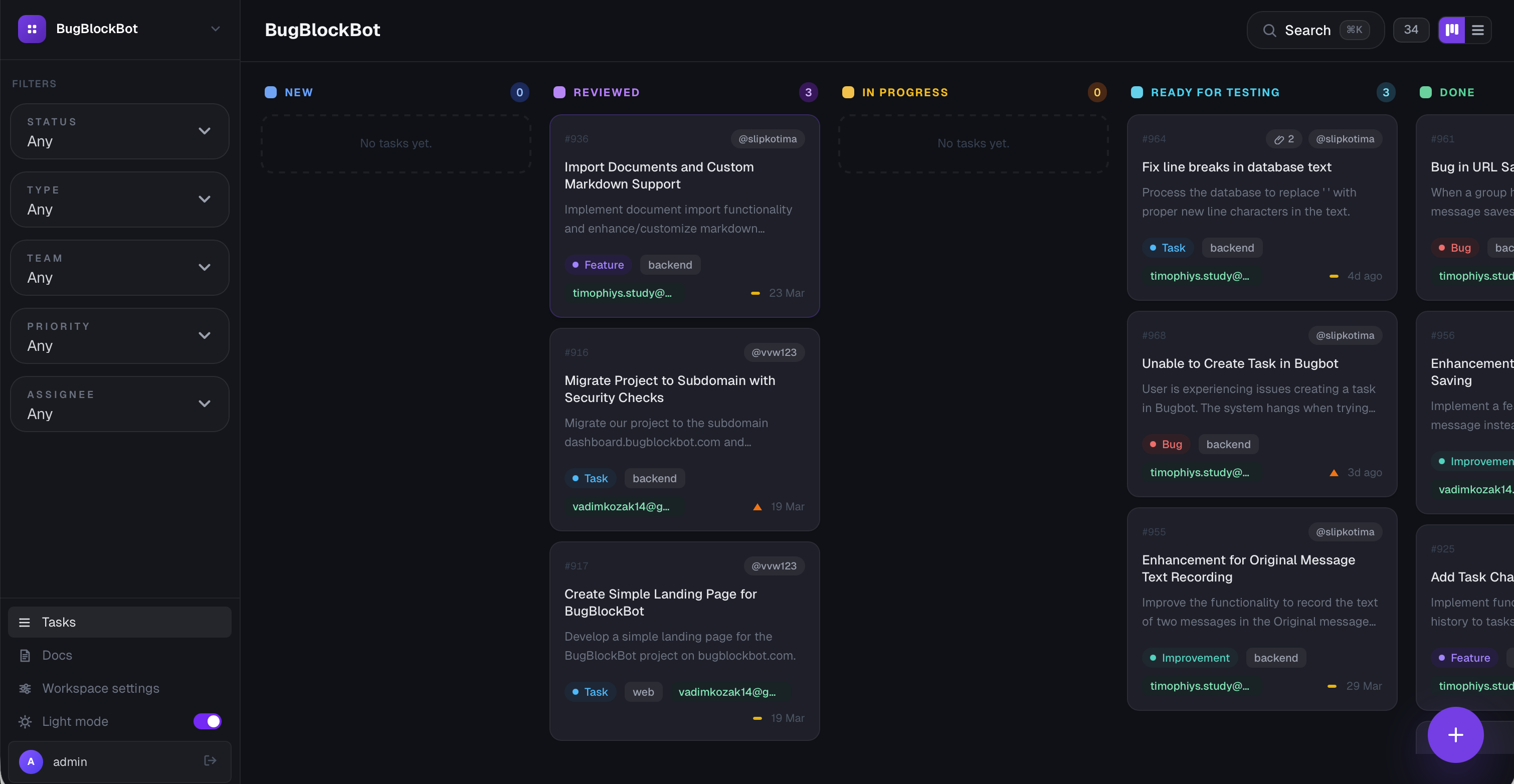
That became the whole idea behind BugBlockBot: mention a bot in Telegram, let it turn the message into a structured ticket, attach the screenshots or files from the original conversation, suggest the correct assignee, and drop it straight into a board the team can actually use.
We built the first real version in one week, with roughly 20 hours of actual focused implementation time.
The Pain Was Not "Bug Tracking"
The pain was leakage.
A bug would be reported in chat. Somebody would react to it. Somebody else would say "I’ll create a task." Then an hour later the chat kept moving, the context got buried, screenshots stayed in Telegram, and the task in ClickUp ended up thinner than the real conversation that created it.
That gap creates a lot of quiet damage:
- details get lost
- engineers receive weak tickets
- QA repeats itself
- product managers become copy-paste machines
- urgent bugs wait because no one wants to do the admin first
And then there is the emotional part: it feels terrible to pay good money for software that still leaves the ugliest part of the workflow on your shoulders.
That was our situation.
The Idea Was Very Small
We did not start from features. We started from one sentence:
what if a bug report in Telegram could become a ticket without anyone retyping it?
From there the requirements became obvious:
- create a ticket directly from a chat message
- keep the original text, screenshots, and files
- link back to the original Telegram message
- structure the issue into title, description, priority, team, and type
- suggest or set the right assignee
- make it visible in a clean board immediately
That is a much smaller promise than "replace ClickUp."
But it is exactly the promise we needed.
How It Works
The product flow is simple on purpose:
- Someone mentions the workspace bot in Telegram or replies to a message.
- The backend receives the message, files, and message link.
- AI helps shape that messy text into a structured ticket.
- The system suggests the right team member when confidence is good enough.
- The ticket appears immediately in the web app board.
- Anyone can still open the original Telegram context when they need the full story.
That solved the exact break in the workflow: no more "I’ll create a task later."
The message becomes the task while the context is still alive.
We Built It in One Week
The total build was about one week and around 20 hours of focused work.
That only worked because we stayed brutally scoped. We did not build another giant product-management tool. We built the missing bridge between chat and execution.
We also used different AI agents during implementation to move faster on repetitive work:
- drafting and reshaping UI pieces
- generating repetitive CRUD scaffolding
- speeding up refactors
- tightening small implementation details that would otherwise eat hours
That did not remove engineering work. It compressed the boring parts.
The product decisions, architecture, debugging, and final review still stayed human. But AI agents absolutely helped us move faster than a normal one-week internal build.
The Stack
We chose a stack that was fast to ship and easy to reason about:
- Telegram Bot API for message intake
- Go for the backend, bot runner, REST API, and file handling
- OpenAI
gpt-4o-minifor turning raw chat messages into structured issue data - assignee suggestion logic based on roles, workload, and confidence
- SQLite by default, with PostgreSQL support when needed
- Next.js + React for the web app and kanban board
- local file storage for screenshots and uploaded documents
The backend handles ticket creation, comments, history, docs, workspace users, repositories, bot management, and attachments. The frontend handles the operational side: board view, list view, search, ticket detail pages, settings, share links, and import flows.
That was enough.
The Important Part About AI
The AI part is small, and that is why it is useful.
We did not build "an AI bug tracker."
We used AI for the exact job where it helps:
- turning messy human text into structured issue fields
- translating rough messages into clearer English when needed
- helping identify likely owners
That is it.
If there is no API key, the system still works. A ticket can still be created. That was an important design choice. AI makes the intake cleaner and faster, but it is not allowed to become a single point of failure.
We Also Needed a Real Escape Hatch From ClickUp
If the only way to adopt a new tool is to abandon everything already inside the old one, most teams will never switch.
So we added ClickUp CSV import too.
That matters more than it sounds. Migration is where a lot of internal tools die. They are "good enough for new stuff" but not good enough to replace the mess the team already has.
BugBlockBot had to be usable on day two, not just interesting on day one.
So beyond ticket intake, it also got:
- ClickUp CSV import
- Telegram attachments and imported files
- comments and activity history
- docs inside each workspace
- shareable ticket links
- multiple workspaces with separate users, repositories, and roles
- board and list views
- search across tickets
That is what turned it from "a bot demo" into an actual working service.
Why This Felt Better Than Paying for SaaS
The obvious savings are financial.
$300 a month is real money. Over a year that is $3,600, and that is before you count the cost of engineers, QA, or PMs constantly redoing work between chat and task software.
But the bigger win was emotional and operational.
Now the place where the bug appears is connected to the place where the team works on it.
That means less friction, less forgetting, less cleanup, and less resentment toward the tooling itself.
That was the goal from the start.
Not more features. Less pain.
The Broader Lesson
Not every SaaS should be replaced.
Most teams should buy, not build.
But when all of these are true:
- the workflow is narrow and frequent
- the off-the-shelf product creates daily friction
- the first useful version is small enough to ship quickly
- the recurring subscription cost is high enough to justify focused engineering time
then a week-long focused build can be more rational than another year of subscriptions and workflow irritation.
That was BugBlockBot.
It started with pain in messenger. It became a simple idea. It turned into a working product in one week and about 20 hours of effort.
And now the repo is open source because we are probably not the only team that got tired of paying for software that still made bug tracking feel manual.
Repo
github.com/verum-astra/bug-block-bot
Thinking about replacing a bloated internal workflow with a smaller custom product? Get in touch — this is exactly the kind of focused software we like building.